> ## Documentation Index
> Fetch the complete documentation index at: https://docs.rxresu.me/llms.txt
> Use this file to discover all available pages before exploring further.
# What's new in v6
> A guide for returning users: how Reactive Resume v6 reorganizes documents, the editor, sharing, the assistant, cover letters, applications and settings.
Reactive Resume v6 is a full redesign. Your resumes, letters and applications carry over, but many things live in new
places. This page explains what changed from v5 and where to find what you used before.
 ## At a glance
| In v5 | In v6 |
| - | - |
| Separate **Resumes** and **Cover Letters** dashboards | One **Documents** page with **All**, **Resumes** and **Letters** tabs |
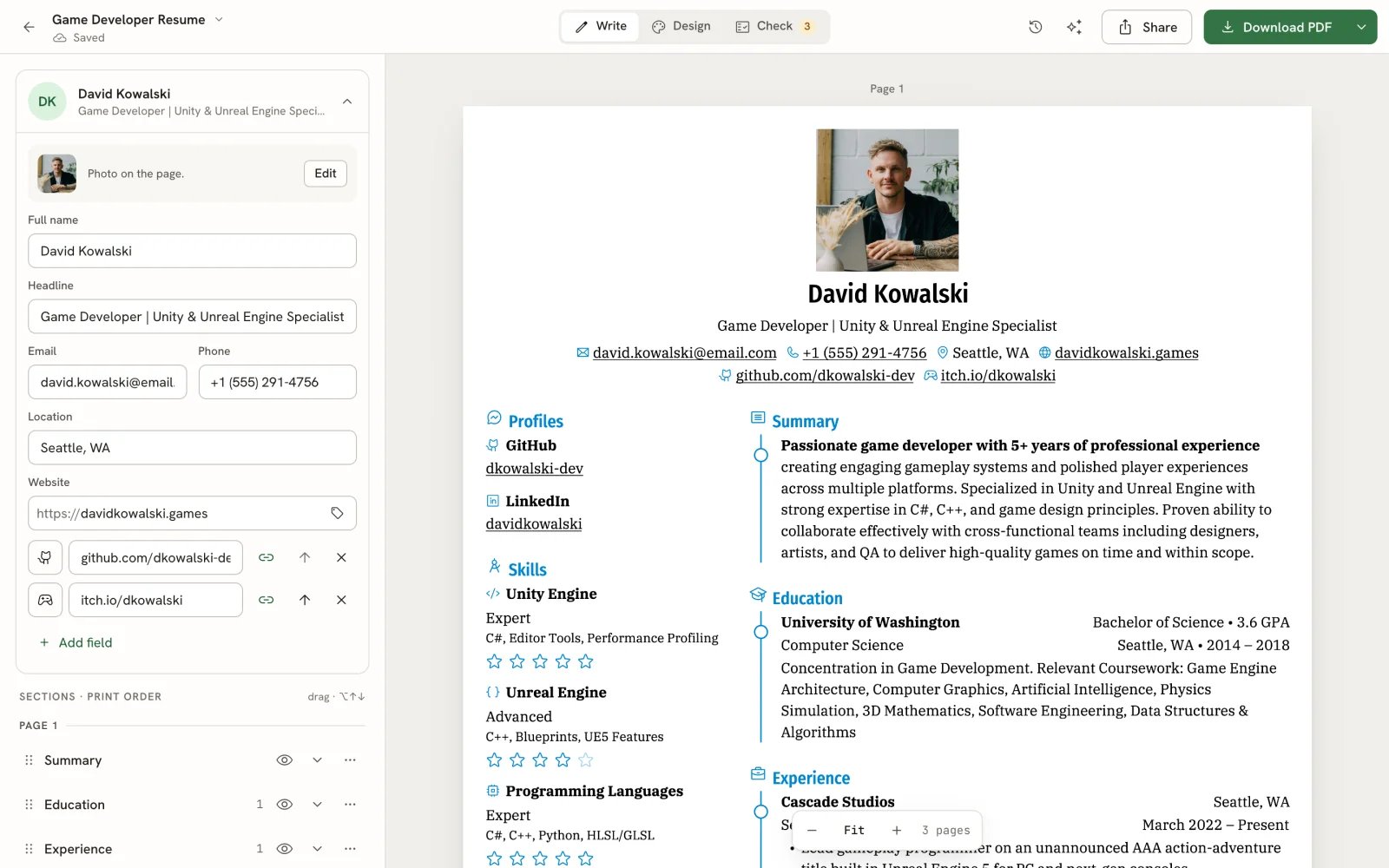
| Builder with left and right sidebars and a dock | Editor with three modes: **Write**, **Design** and **Check** |
| Export panel, sharing section and version history | One **Share & export** panel with **Link**, **Download** and **History** tabs |
| **Agents** page and the builder's AI sheet | The **Assistant** panel inside the editor (⌘ J) |
| Cover letters inside resumes, or in their own library | Cover letters are documents of their own |
| Applications table, board and insights | Applications **List**, **Board**, **Insights** and **Calendar** |
| Dates typed as free text | Structured dates: a month and year, or just a year |
| Six settings pages | **Settings** with **Account**, **Preferences** and **AI & developer** |
## Documents replaces the dashboards
The **Resumes** and **Cover Letters** pages are now one page, **Documents**. Use the tabs to show everything, only
resumes or only letters, search with /, sort by **Last edited**, and switch between a grid and a list.
Old links to the resume and letter dashboards still open **Documents**.
Everything you create starts from **New** in the sidebar (or press N). The **New document** dialog offers
**Import a resume**, **Copy a resume for a job**, **Start blank**, **New cover letter instead** and **Try with a sample
resume**. You can also drop a file anywhere on **Documents** to import it.
Deleting a document now moves it to **Trash**, with an undo. Documents stay in Trash for 30 days, and you can restore
them or delete them for good before then. The **Trash** link appears in the sidebar only while Trash has something in
it.
Learn more in [Managing documents](/guides/managing-documents) and [Using the Trash](/guides/using-the-trash).
## The editor has three modes
The builder's sidebars, dock and panels are replaced by one editor with three modes. Switch with the control at the top
of the editor, or press 1, 2 or 3.
* **Write** holds your content: the **Basics** card (name, photo, contact details and custom fields), then your
sections in print order. Each section and entry has a **⋯** menu for options such as hiding, duplicating or moving
it. You can also select a block on the page to jump to it in the panel.
* **Design** holds the look: **Template**, **Type**, **Color**, **Page** and **Advanced** (custom fonts, the date
format, custom CSS and more). The template gallery shows all 17 templates filled with your own content.
* **Check** reviews your resume. It lists issues pinned to the lines they belong to and gives a readability score, a
**Job match** against a posting, and an AI **Writing** review. It replaces the ATS section of the old builder; the
public [ATS checker](/guides/using-the-ats-checker) page is still available.
The document name at the top left opens the document menu: **Rename…**, **Duplicate**, **Lock editing**, **Notes**,
**Details**, **Print** and **Move to Trash**. Private notes and printing moved here.
Learn more in [Editor overview](/guides/editor-overview) and [Checking your resume](/guides/checking-your-resume).
## Sharing, downloads and history live in one place
**Share** in the editor bar opens the **Share & export** panel. It has three tabs:
* **Link** turns your public link on or off, sets its address, can **Require a password**, and shows views and
downloads for the last 30 days. The public address moved here from the old "edit details" dialog.
* **Download** saves a **PDF**, **Word**, **Markdown** or **JSON** file, with a file name you can change.
* **History** lists earlier versions of your document. You can name a version (for example, the one you sent to a
company), preview it and restore it. Restoring no longer asks for confirmation, because it can be undone: your
state before the restore is kept as a version called **Before restore**.
**Download PDF** in the editor bar downloads right away, and ⌘ P now downloads the PDF instead of
opening the print dialog. To print, use **Print** in the document menu.
Learn more in [Sharing your resume publicly](/guides/sharing-your-resume-publicly),
[Exporting your resume](/guides/exporting-your-resume) and
[Undoing changes and version history](/guides/undoing-changes-and-version-history).
## The Assistant replaces Agents
The separate **Agents** page is gone. The AI assistant now opens as a panel beside the page in the editor, for resumes
and letters alike. Open it with the sparkle button in the editor bar or ⌘ J.
The biggest change: the assistant never edits your document directly. It proposes edits, showing the old text struck
through, the new text and why, and you accept or reject each one. It can ask you a clarifying question
when a request is unclear. Your earlier conversations are under **Past conversations** in the panel, and old Agents
links open the right document with the conversation showing.
The assistant, **Improve** on a line of text, and Check's **Writing** review use an AI provider you connect yourself in
**Settings → AI & developer**.
Learn more in [Connecting an AI provider](/guides/using-ai) and [Using the assistant](/guides/using-the-assistant).
## Cover letters are documents of their own
In v5, a cover letter could be a section inside a resume. In v6, every letter is its own document in **Documents**,
with its own editor (**Write** and **Design** modes), downloads and history. A letter can be linked to a resume, and it
then uses that resume's contact details and design unless you give the letter its own design.
When your account moved to v6, every cover-letter section in your resumes was saved as a separate letter linked to that
resume, named after the resume and the section. The resumes themselves no longer contain letters. Letters don't have
public links.
Learn more in [Writing a cover letter](/guides/writing-a-cover-letter).
## Applications got a redesign
The job tracker now has four views: **List**, **Board**, **Insights** and **Calendar**. On phones, the list is used
in place of the board and calendar.
* **Add application** starts from a job link or a pasted posting.
* Each application moves through **Saved**, **Applied**, **Screening**, **Interview** and **Offer**. When it ends, you
close it with a reason instead of marking it rejected or archiving it. Use **Show closed** to see closed ones.
* Selecting an application opens its detail sheet with the stage, the next step (interviews and follow-ups), what you
sent, notes, contacts and activity.
* The **Calendar** view shows your interviews. **Add to calendar** on an interview saves it as an `.ics` file for your
own calendar app.
* From an application, you can tailor a resume or write a letter for that job.
Learn more in [Tracking job applications](/guides/tracking-job-applications) and
[Tailoring a resume for a job](/guides/tailoring-a-resume-for-a-job).
## Dates are structured
Dates used to be free text. Now each date is a month and year (such as Mar 2022) or just a year, and ongoing entries
use **Present**. Because Reactive Resume understands the dates, it can sort entries and check them, and every date on
your resume prints the same way. Choose how they print in **Design → Advanced → Date format**: Mar 2022, March 2022,
03/2022 or 2022-03.
Your existing dates were converted automatically. Anything that couldn't be read exactly, such as "Summer 2016", still
prints as you wrote it until you edit that date.
Learn more in [Entering dates](/guides/entering-dates).
## A new PDF engine that runs in your browser
The page you see in the editor is the real PDF, rendered in your browser as you type. Downloads are made in your
browser too, so they match the preview exactly and don't wait for a server. The engine runs in the background, so
typing stays responsive even on long resumes.
## Settings are consolidated
The six settings pages are now three. To open them, select your name at the bottom of the sidebar, then **Settings**:
* **Account**: your profile and photo, password, two-step verification, passkeys and linked sign-in methods, exporting
all your data, and deleting your account. **Sign out** is here too.
* **Preferences**: appearance (**Light**, **Dark**, or following your system), language and motion.
* **AI & developer**: AI providers, API keys and the MCP server.
Old settings links open the matching new page.
Learn more in [Updating your profile](/guides/updating-your-profile) and
[Changing appearance and language](/guides/changing-appearance-and-language).
## Faster ways to get around
Press ⌘ K (Ctrl K on Windows and Linux) anywhere to open the command bar.
Search your resumes, applications and assistant conversations, jump to a page, change the theme or language, or type a
question to ask the assistant. See [Using the command bar](/guides/using-the-command-bar) and the full list of
[keyboard shortcuts](/guides/keyboard-shortcuts).
## What was removed
A few v5 features didn't make it into v6:
* The compact view on the resume dashboard (grid and list remain) and the collapsible sidebar.
* Automatically applied AI edits. Every assistant edit is now a proposal you review.
* Adding a cover letter inside a resume, and the cover-letter tab in a resume's downloads. Use a separate letter.
* Archiving assistant conversations and showing token counts.
* The fit score stored on applications.
## If you self-host
Upgrading your own server from v5 to v6 involves database migrations and a few API changes. Follow
[Upgrading to v6](/self-hosting/upgrading-to-v6) before you update.
This documentation is built and hosted on [Mintlify](https://mintlify.com), a developer documentation platform.
## At a glance
| In v5 | In v6 |
| - | - |
| Separate **Resumes** and **Cover Letters** dashboards | One **Documents** page with **All**, **Resumes** and **Letters** tabs |
| Builder with left and right sidebars and a dock | Editor with three modes: **Write**, **Design** and **Check** |
| Export panel, sharing section and version history | One **Share & export** panel with **Link**, **Download** and **History** tabs |
| **Agents** page and the builder's AI sheet | The **Assistant** panel inside the editor (⌘ J) |
| Cover letters inside resumes, or in their own library | Cover letters are documents of their own |
| Applications table, board and insights | Applications **List**, **Board**, **Insights** and **Calendar** |
| Dates typed as free text | Structured dates: a month and year, or just a year |
| Six settings pages | **Settings** with **Account**, **Preferences** and **AI & developer** |
## Documents replaces the dashboards
The **Resumes** and **Cover Letters** pages are now one page, **Documents**. Use the tabs to show everything, only
resumes or only letters, search with /, sort by **Last edited**, and switch between a grid and a list.
Old links to the resume and letter dashboards still open **Documents**.
Everything you create starts from **New** in the sidebar (or press N). The **New document** dialog offers
**Import a resume**, **Copy a resume for a job**, **Start blank**, **New cover letter instead** and **Try with a sample
resume**. You can also drop a file anywhere on **Documents** to import it.
Deleting a document now moves it to **Trash**, with an undo. Documents stay in Trash for 30 days, and you can restore
them or delete them for good before then. The **Trash** link appears in the sidebar only while Trash has something in
it.
Learn more in [Managing documents](/guides/managing-documents) and [Using the Trash](/guides/using-the-trash).
## The editor has three modes
The builder's sidebars, dock and panels are replaced by one editor with three modes. Switch with the control at the top
of the editor, or press 1, 2 or 3.
* **Write** holds your content: the **Basics** card (name, photo, contact details and custom fields), then your
sections in print order. Each section and entry has a **⋯** menu for options such as hiding, duplicating or moving
it. You can also select a block on the page to jump to it in the panel.
* **Design** holds the look: **Template**, **Type**, **Color**, **Page** and **Advanced** (custom fonts, the date
format, custom CSS and more). The template gallery shows all 17 templates filled with your own content.
* **Check** reviews your resume. It lists issues pinned to the lines they belong to and gives a readability score, a
**Job match** against a posting, and an AI **Writing** review. It replaces the ATS section of the old builder; the
public [ATS checker](/guides/using-the-ats-checker) page is still available.
The document name at the top left opens the document menu: **Rename…**, **Duplicate**, **Lock editing**, **Notes**,
**Details**, **Print** and **Move to Trash**. Private notes and printing moved here.
Learn more in [Editor overview](/guides/editor-overview) and [Checking your resume](/guides/checking-your-resume).
## Sharing, downloads and history live in one place
**Share** in the editor bar opens the **Share & export** panel. It has three tabs:
* **Link** turns your public link on or off, sets its address, can **Require a password**, and shows views and
downloads for the last 30 days. The public address moved here from the old "edit details" dialog.
* **Download** saves a **PDF**, **Word**, **Markdown** or **JSON** file, with a file name you can change.
* **History** lists earlier versions of your document. You can name a version (for example, the one you sent to a
company), preview it and restore it. Restoring no longer asks for confirmation, because it can be undone: your
state before the restore is kept as a version called **Before restore**.
**Download PDF** in the editor bar downloads right away, and ⌘ P now downloads the PDF instead of
opening the print dialog. To print, use **Print** in the document menu.
Learn more in [Sharing your resume publicly](/guides/sharing-your-resume-publicly),
[Exporting your resume](/guides/exporting-your-resume) and
[Undoing changes and version history](/guides/undoing-changes-and-version-history).
## The Assistant replaces Agents
The separate **Agents** page is gone. The AI assistant now opens as a panel beside the page in the editor, for resumes
and letters alike. Open it with the sparkle button in the editor bar or ⌘ J.
The biggest change: the assistant never edits your document directly. It proposes edits, showing the old text struck
through, the new text and why, and you accept or reject each one. It can ask you a clarifying question
when a request is unclear. Your earlier conversations are under **Past conversations** in the panel, and old Agents
links open the right document with the conversation showing.
The assistant, **Improve** on a line of text, and Check's **Writing** review use an AI provider you connect yourself in
**Settings → AI & developer**.
Learn more in [Connecting an AI provider](/guides/using-ai) and [Using the assistant](/guides/using-the-assistant).
## Cover letters are documents of their own
In v5, a cover letter could be a section inside a resume. In v6, every letter is its own document in **Documents**,
with its own editor (**Write** and **Design** modes), downloads and history. A letter can be linked to a resume, and it
then uses that resume's contact details and design unless you give the letter its own design.
When your account moved to v6, every cover-letter section in your resumes was saved as a separate letter linked to that
resume, named after the resume and the section. The resumes themselves no longer contain letters. Letters don't have
public links.
Learn more in [Writing a cover letter](/guides/writing-a-cover-letter).
## Applications got a redesign
The job tracker now has four views: **List**, **Board**, **Insights** and **Calendar**. On phones, the list is used
in place of the board and calendar.
* **Add application** starts from a job link or a pasted posting.
* Each application moves through **Saved**, **Applied**, **Screening**, **Interview** and **Offer**. When it ends, you
close it with a reason instead of marking it rejected or archiving it. Use **Show closed** to see closed ones.
* Selecting an application opens its detail sheet with the stage, the next step (interviews and follow-ups), what you
sent, notes, contacts and activity.
* The **Calendar** view shows your interviews. **Add to calendar** on an interview saves it as an `.ics` file for your
own calendar app.
* From an application, you can tailor a resume or write a letter for that job.
Learn more in [Tracking job applications](/guides/tracking-job-applications) and
[Tailoring a resume for a job](/guides/tailoring-a-resume-for-a-job).
## Dates are structured
Dates used to be free text. Now each date is a month and year (such as Mar 2022) or just a year, and ongoing entries
use **Present**. Because Reactive Resume understands the dates, it can sort entries and check them, and every date on
your resume prints the same way. Choose how they print in **Design → Advanced → Date format**: Mar 2022, March 2022,
03/2022 or 2022-03.
Your existing dates were converted automatically. Anything that couldn't be read exactly, such as "Summer 2016", still
prints as you wrote it until you edit that date.
Learn more in [Entering dates](/guides/entering-dates).
## A new PDF engine that runs in your browser
The page you see in the editor is the real PDF, rendered in your browser as you type. Downloads are made in your
browser too, so they match the preview exactly and don't wait for a server. The engine runs in the background, so
typing stays responsive even on long resumes.
## Settings are consolidated
The six settings pages are now three. To open them, select your name at the bottom of the sidebar, then **Settings**:
* **Account**: your profile and photo, password, two-step verification, passkeys and linked sign-in methods, exporting
all your data, and deleting your account. **Sign out** is here too.
* **Preferences**: appearance (**Light**, **Dark**, or following your system), language and motion.
* **AI & developer**: AI providers, API keys and the MCP server.
Old settings links open the matching new page.
Learn more in [Updating your profile](/guides/updating-your-profile) and
[Changing appearance and language](/guides/changing-appearance-and-language).
## Faster ways to get around
Press ⌘ K (Ctrl K on Windows and Linux) anywhere to open the command bar.
Search your resumes, applications and assistant conversations, jump to a page, change the theme or language, or type a
question to ask the assistant. See [Using the command bar](/guides/using-the-command-bar) and the full list of
[keyboard shortcuts](/guides/keyboard-shortcuts).
## What was removed
A few v5 features didn't make it into v6:
* The compact view on the resume dashboard (grid and list remain) and the collapsible sidebar.
* Automatically applied AI edits. Every assistant edit is now a proposal you review.
* Adding a cover letter inside a resume, and the cover-letter tab in a resume's downloads. Use a separate letter.
* Archiving assistant conversations and showing token counts.
* The fit score stored on applications.
## If you self-host
Upgrading your own server from v5 to v6 involves database migrations and a few API changes. Follow
[Upgrading to v6](/self-hosting/upgrading-to-v6) before you update.
This documentation is built and hosted on [Mintlify](https://mintlify.com), a developer documentation platform.